To individualise the door I chose to embellish the lower panel in a similar fashion to the shamrocks on Foynes;
http://www.winkieg.blogspot.com.au/2012/08/67-front-door-part-1.html.
Lots of ideas passed through my head, but my love of the Quercus genus
and the slowly expanding plantation of these here for my Truffle
venture, had me settle on the carving of an Oak leaf.
As we were now well into Autumn, there was plenty of leaves on the ground, from the myriad of variety's of Oak planted all around the property. I picked through the piles, collecting as diverse a range of leaf shapes as possible for a final selection.
For me, the best example that represented the Genus, that was also of pleasing proportions was the smallest one in the above photo. It belongs to Quercus Robur, the English Oak, probably the most widely planted variety in Australia, hence the familiarity. I photocopied the leaf and enlarged the image until a suitable size was attained for tracing on to the panels.
Some of the other leaves shown are a selection of American variety's, with the deeper lobes, Canary Oak, in the centre and some Mediterranean variety's, with the serrated edges.
The door was to be made entirely from Lebanese Cedar. I formed all the panels in the same way, laminating various pieces together to make up the widths and then applying bookmatched veneers to the inside faces. The bulk of the waste was then removed from the front. The edges of the raised section on the panels were routed to the finished profile with extra thickness allowed for the patterns.
Using various templates and jigs, a rough outline of the leaf shape was routed out. This ensured a flat and even background was attained. The leaf was then more finely carved to profile with chisels and the surface was veined and lightly contoured, to give it a bit more life.
The shield patterns on the upper and intermediate panels were routed using mdf templates and a bastardised rounding over bit. I couldn't locate a suitably profiled bit from the local suppliers, so the nearest alternative I could procure was carefully ground on the bench grinder, until it was close enough to the right size.
The door was assembled using the normal methods of wedged mortise and tenon joints. I ran a large quantity of bolection mouldings, more than sufficient for all of my external doors. This was owing to the amount of setup required, for the multiple passes over the router table, to achieve the desired finished profile. From memory these totalled about 7, not including the initial sizing and the final rebating. The rebates are matched to suit individual doors, dependant on the depth of the finished panel from the face.
Once completed, the hinges were sunk and the door was hung and lightly trimmed to suit the opening. The inside face was finish sanded, then, as per the frame, was also stained and lacquered before final installation.
A suitable mortice lock for the door proved rather difficult to source. Currently, the lock ranges available, incorporating a brass finish are very limited, the common response from suppliers was that it's now "out of fashion". The combination of a long case, to provide a greater visual separation of the handle from the key barrel, and the correct 'backset', left only one available option, which had to be ordered from the manufacturer in Tasmania. Unfortunately though, the supplied striker plate, the only that was available for this model, was a universal fit that looked rather flimsy and daggy with it's one long slot. Visits to a couple of restoration supplies found nothing else suitable, so I sourced some brass plate and made my own!.
The hole is finally plugged. Plywood was cut to temporarily fill the glazed openings until the leadlights are designed and made.
The shameful self promotion couldn't be helped for this external shot, the ladder is lashed to the scaffold in that position, for access higher up!.
The only thing left to be done now, before painting, is the carved Brackets, (or Modillions), which sit above the capitals, the subject of the next post.
Sunday, August 4, 2013
Monday, July 22, 2013
75, Front Door, part 6. Installation.
Monday, the 13th of May, was a bit of a highlight for me. The frame was finally ready to be installed. All the loose bits were taken off and put aside, then, with the aid of a number of ropes and shackles, I lifted it off the stools and dropped one side to the floor.
Resting on the reveal, I was then able to slide the unit through to the entry, where, using the ropes again, I lowered it flat to the floor. The temporary frames were left in the corner sash openings to help avoid any damage.
With the bottom positioned on the cill, I reattached ropes to the head and via shackles, fed it up to the rafters and back down to within easy reach. I was able to lift it up in stages by hand, holding it, after each grunt, by the rope. Owing to imperfections in the hand hewn bluestone cill, which I felt would be too hard to copy to the timberwork via measurements or templates, I opted to leave the frame slightly oversize and mark scribe lines on it, once in position. This, thankfully, worked satisfactorily the first time and I only needed to lower it back down once for trimming.
I was more than happy with the fit, just like the proverbial glove. The sides were screwed, through the reveals, into trimmers bolted to the stonework.
The stone cill already had holes sunk into it from it's previous life and I was careful to make sure that the mullions would cover them when designing the frame.
Grooves were chiseled in the base of the frame and the pedestal backing block to accommodate a stainless steel bolt. The bolt was then epoxied in place, sandwiched between the timbers with the head located into the rearmost hole.
With the frame all secured in place, the sashes were trimmed and fitted and a start was made on the attaching of the appendages.
First up, the pedestals were boxed out and capped. The Lebanese cedar that I used for these and the upper portions of the plinth, came from a tree removed From Kardinia park in Geelong. The poorer, slower growing conditions there, other than that at Daylesford, from where the rest of my supply originated, created a tighter more attractive figure in the timber. The difference is quite apparent in the above photo, where a comparison can be made with the infill panel. For the lower, larger portion of the plinth, I used Celery top pine, which, being much more dense, should cope better with any knocking or scuffing.
During assembly, I am placing the "grease proof" paper behind the timber, to avoid getting paint all over the stonework. Hopefully it can simply and cleanly be pulled out later.
Resting on the reveal, I was then able to slide the unit through to the entry, where, using the ropes again, I lowered it flat to the floor. The temporary frames were left in the corner sash openings to help avoid any damage.
With the bottom positioned on the cill, I reattached ropes to the head and via shackles, fed it up to the rafters and back down to within easy reach. I was able to lift it up in stages by hand, holding it, after each grunt, by the rope. Owing to imperfections in the hand hewn bluestone cill, which I felt would be too hard to copy to the timberwork via measurements or templates, I opted to leave the frame slightly oversize and mark scribe lines on it, once in position. This, thankfully, worked satisfactorily the first time and I only needed to lower it back down once for trimming.
I was more than happy with the fit, just like the proverbial glove. The sides were screwed, through the reveals, into trimmers bolted to the stonework.
The stone cill already had holes sunk into it from it's previous life and I was careful to make sure that the mullions would cover them when designing the frame.
Grooves were chiseled in the base of the frame and the pedestal backing block to accommodate a stainless steel bolt. The bolt was then epoxied in place, sandwiched between the timbers with the head located into the rearmost hole.
With the frame all secured in place, the sashes were trimmed and fitted and a start was made on the attaching of the appendages.
First up, the pedestals were boxed out and capped. The Lebanese cedar that I used for these and the upper portions of the plinth, came from a tree removed From Kardinia park in Geelong. The poorer, slower growing conditions there, other than that at Daylesford, from where the rest of my supply originated, created a tighter more attractive figure in the timber. The difference is quite apparent in the above photo, where a comparison can be made with the infill panel. For the lower, larger portion of the plinth, I used Celery top pine, which, being much more dense, should cope better with any knocking or scuffing.
During assembly, I am placing the "grease proof" paper behind the timber, to avoid getting paint all over the stonework. Hopefully it can simply and cleanly be pulled out later.
Sunday, May 12, 2013
74, Front Door, part 5. Corinthian capitals.
Concurrently with the turning of the columns, much work progressed on the making of the Corinthian capitals to crown them. Ultimately it took many more hours to produce these relatively small features, than the making of the columns themselves.
For the patterns, I had sourced some original odd metal pieces of suitable verandah post capitals from a local house wrecker, one full quarter and a couple of half quarters. As procured, they were relatively plain, having been coated with a thick layer of some sort of putty and numerous coats of paint.
The first step was to remove the coatings. A handy bit of advice had me cooking it on the stove, in a pot of boiling water with a bit of bicarbonate of soda added. It worked a treat, with the layers literally falling off.
The full piece was scrubbed completely clean and mounted in a rough box, then casting plaster was poured around it to fill the voids. A remeltable rubber was then used to make a mould. The product, sold locally as "Gelflex", works out at close to the same price as conventional 2 part silicone rubber, but being reusable works out far cheaper in the long run.
From the rubber mould, (it took a couple of go's to get that right), I cast an oversize model, to give me more width at the bottom. The original pieces were of the desired proportions at the top, however, they were a little too high for my purpose and they were made to fit around a 75mm, (3 inch), post. My columns were 90mm diameter.
The hours ticked by as I reshaped and carved the plaster model to achieve the result shown on the left. I wasn't entirely happy with the shape that I ended up with, as it tended to flare back outwards at the bottom, creating a narrow neck. I was loathe to redo it, given the time spent. Ultimately though, I was unsuccessful in attempting to mould it. I had coated it with various different products, including silicon spray, to seal the plaster to prevent air escaping into and bubbling the hot rubber. This was all to the detriment of the model and I started over again, producing the second one, on the right with the more pleasing profile.
The bottom section on the models was also made a little wider to avoid having to piece in small fillets at the rear, where the 'not required' fourth piece would have fitted, against the mullion.
My attempts to mould the second model were also not without problems. Much google searching had a supplier of of a similar product, "Flexil",recommending sealing the plaster with a number of coats of diluted PVA glue. This was the only advice I was able to locate, other than "the plaster must be sealed"!. They also recommended providing ventilation holes below the unsealed base of the model. I tried this to no avail, having worse results than before with the rubber bubbling excessively and setting like a sponge. At that point I could see the only solution to be to coat it with a thin layer of epoxy and sealing it to the baseboard. This did prove satisfactory, however, around the sides, where I had applied the coating a lot thicker, the heat softened the layer, causing it to blister. Fortunately, the face moulded well and I was able to get on with casting the finished product.
For the ten pieces I required, I cast them using an epoxy resin; nuplexcomposites Epoxy R180. In order to reduce the amount of resin used, and therefore reduce the cost, this was bulked out, to over twice it's volume, with the addition of hollow glass spheres. These also lightened the weight and gave them the white colour.
I gave them a couple of days to harden sufficiently before trimming the mitres and gluing them together. Once assembled, the backs were cut roughly to shape and the capitals were clamped down as seen in the picture. To reduce wastage, all the offcuts were reused, hacked into smaller pieces and placed in the centres with more epoxy mixed to fill the voids. As I looked at this scene before taking the photo, I realised how stupid I was with the risk I was taking, with this being carried out on a board sitting on the completed frame. Should a clamp slip or fail, I would have a hell of a mess oozing all over the finished work!.
Leaving the castings to fully harden, I turned my attention to the arris mouldings. The positions of these could now be marked out, corresponding with the profiles of the columns. Routing the ovolo shape was the easy part, Carving the bevelled chamfers at the ends, however, tested my patience. I had considered a "lambs tongue" profile for these, but on a sample test piece the plain bevel proved to be difficult enough, maintaining the flat plane around the ovolo curve. I tried grinding the cutting edge of a chisel into a curve to trim the convex shape into the transition point, but found that I was able to achieve better results using a plain flat chisel instead.
For smoothing the ends of the ovolo, I whipped up a couple of small sanders. The first, I made using sections of plastic conduit, laminated together and attached to a handle. The lower most section had the sandpaper glued to it, pressed in place using some dowel, before it was glued to the remainder. With this needing some time to dry, owing to the solvent based glue used, I whipped up a second one. This time, I used a short length of scotia moulding, fixed to a handle before having the sandpaper glued on. The ends of both were roughly curved to the correct shape with an angle grinder, the only thing I could think of that would not be damaged by the silicone carbide abrasive paper I had used.
With all the major components ready to go, I screwed and glued lengths of 18mm marine ply "reveals" to the two sides. These would give me something to fix through to secure the frame to the jambs. The dentils were made up in a long strip from thin marine ply, being a 'T' shape in vertical section. They were then docked off in 25mm widths and glued and tacked in position. The capitals were then trimmed up and sanded and a final dry assembly was made, to see how it all looked.
Still to be done, apart from the pedestal caps and bases, are the carved modillions, that sit on top of the capitals. These will be tackled after installation of the frame, when more accurate dimensions can be measured.

For the patterns, I had sourced some original odd metal pieces of suitable verandah post capitals from a local house wrecker, one full quarter and a couple of half quarters. As procured, they were relatively plain, having been coated with a thick layer of some sort of putty and numerous coats of paint.
The first step was to remove the coatings. A handy bit of advice had me cooking it on the stove, in a pot of boiling water with a bit of bicarbonate of soda added. It worked a treat, with the layers literally falling off.
The full piece was scrubbed completely clean and mounted in a rough box, then casting plaster was poured around it to fill the voids. A remeltable rubber was then used to make a mould. The product, sold locally as "Gelflex", works out at close to the same price as conventional 2 part silicone rubber, but being reusable works out far cheaper in the long run.
From the rubber mould, (it took a couple of go's to get that right), I cast an oversize model, to give me more width at the bottom. The original pieces were of the desired proportions at the top, however, they were a little too high for my purpose and they were made to fit around a 75mm, (3 inch), post. My columns were 90mm diameter.
The hours ticked by as I reshaped and carved the plaster model to achieve the result shown on the left. I wasn't entirely happy with the shape that I ended up with, as it tended to flare back outwards at the bottom, creating a narrow neck. I was loathe to redo it, given the time spent. Ultimately though, I was unsuccessful in attempting to mould it. I had coated it with various different products, including silicon spray, to seal the plaster to prevent air escaping into and bubbling the hot rubber. This was all to the detriment of the model and I started over again, producing the second one, on the right with the more pleasing profile.
The bottom section on the models was also made a little wider to avoid having to piece in small fillets at the rear, where the 'not required' fourth piece would have fitted, against the mullion.
My attempts to mould the second model were also not without problems. Much google searching had a supplier of of a similar product, "Flexil",recommending sealing the plaster with a number of coats of diluted PVA glue. This was the only advice I was able to locate, other than "the plaster must be sealed"!. They also recommended providing ventilation holes below the unsealed base of the model. I tried this to no avail, having worse results than before with the rubber bubbling excessively and setting like a sponge. At that point I could see the only solution to be to coat it with a thin layer of epoxy and sealing it to the baseboard. This did prove satisfactory, however, around the sides, where I had applied the coating a lot thicker, the heat softened the layer, causing it to blister. Fortunately, the face moulded well and I was able to get on with casting the finished product.
For the ten pieces I required, I cast them using an epoxy resin; nuplexcomposites Epoxy R180. In order to reduce the amount of resin used, and therefore reduce the cost, this was bulked out, to over twice it's volume, with the addition of hollow glass spheres. These also lightened the weight and gave them the white colour.
I gave them a couple of days to harden sufficiently before trimming the mitres and gluing them together. Once assembled, the backs were cut roughly to shape and the capitals were clamped down as seen in the picture. To reduce wastage, all the offcuts were reused, hacked into smaller pieces and placed in the centres with more epoxy mixed to fill the voids. As I looked at this scene before taking the photo, I realised how stupid I was with the risk I was taking, with this being carried out on a board sitting on the completed frame. Should a clamp slip or fail, I would have a hell of a mess oozing all over the finished work!.
Leaving the castings to fully harden, I turned my attention to the arris mouldings. The positions of these could now be marked out, corresponding with the profiles of the columns. Routing the ovolo shape was the easy part, Carving the bevelled chamfers at the ends, however, tested my patience. I had considered a "lambs tongue" profile for these, but on a sample test piece the plain bevel proved to be difficult enough, maintaining the flat plane around the ovolo curve. I tried grinding the cutting edge of a chisel into a curve to trim the convex shape into the transition point, but found that I was able to achieve better results using a plain flat chisel instead.
For smoothing the ends of the ovolo, I whipped up a couple of small sanders. The first, I made using sections of plastic conduit, laminated together and attached to a handle. The lower most section had the sandpaper glued to it, pressed in place using some dowel, before it was glued to the remainder. With this needing some time to dry, owing to the solvent based glue used, I whipped up a second one. This time, I used a short length of scotia moulding, fixed to a handle before having the sandpaper glued on. The ends of both were roughly curved to the correct shape with an angle grinder, the only thing I could think of that would not be damaged by the silicone carbide abrasive paper I had used.
With all the major components ready to go, I screwed and glued lengths of 18mm marine ply "reveals" to the two sides. These would give me something to fix through to secure the frame to the jambs. The dentils were made up in a long strip from thin marine ply, being a 'T' shape in vertical section. They were then docked off in 25mm widths and glued and tacked in position. The capitals were then trimmed up and sanded and a final dry assembly was made, to see how it all looked.
Still to be done, apart from the pedestal caps and bases, are the carved modillions, that sit on top of the capitals. These will be tackled after installation of the frame, when more accurate dimensions can be measured.
Labels:
casting.,
column,
corinthian,
door,
entrance,
epoxy,
moulding,
ovolo,
stopped chamfer
Thursday, May 2, 2013
73, Front Door, part 4. Bits on the front!.
With the inside surfaces sealed, light temporary frames, about 20mm thicker than the sashes, were lightly fitted into the four corner openings. The frame was then flipped over and rested on these frames, which protected the inside finish.
The entabulature, fixed to the outside face of the transom rail was tackled first. The "Cyma reversa" moulding, being the most difficult section to produce, was machined from some Lebanese cedar using multiple bits and a number of passes over the router table. Once it was ready, fine tuning of the dimensions for the other components could be completed. The frieze pattern, cut out from 6mm Hoop pine marine ply, was varied slightly in the horizontal plane in order to match on the mitres. The "Cap" was machined to a tapered profile and was mitred over all the projections. This had the top surface sloping outwards to prevent the pooling of any moisture.
The untrimmed pieces for the two ends have been left loose at this stage. They will be trimmed to fit neatly against the stone reveals, once the frame is installed.
Making the proverbial "Silk purse from a sows ear".applied to the making of the turned columns. From my stash of "accumulated" timber, I grabbed the most accessible pieces that were of sufficient dimensions and durability, some old 5 inch square, Red gum and Jarrah verandah posts, complete with cracks, charred faces and embedded nails. The nails, some of which had been previously broken off and were hard to detect, obviously needed to be removed, hence the chiseled holes seen in the photo. Only one was missed and ultimately discovered by the roughing gouge when on the lathe!. All the pieces had deep cracks along one face, however as the columns are planed flat at the back, to fit against the mullions, these could be hidden there.
The small shoulders on the ends were cut on the bandsaw for mounting in the lathe chuck, once roughed down, (at a very low speed), a truer rounded shoulder was shaped alongside and the square section cut off. With the blank remounted, a 1 inch diameter hole was drilled in the opposite end to accommodate the "live centre", this hole would be used for dowelling the finished pieces together. The blanks were then returned, down to about 105mm diameter and roughly shaped, as seen in the above photo. The lathe speed was then cranked up for pieces to be finished off and sanded.
The next step was the "fluting" to the lower half of the columns, this I was able to do this on my lathe. I attached my little trimming router to a flat base which would slide on a fabricated a table, bolted onto the lathe bed, all adjusted to align with the horizontal centre line of the work. After much thought on how I could make up an indexing head for the purpose, I found that the shaft lock on the head would serve, having 12 separate positions. Excess slop in the spindle with this method was overcome by filing down a screwdriver shaft to as tight a fit in the locking hole as possible and then clamping it down firmly for each flute.
More than happy with the results, the first one is completed and the next is waiting for it's turn in the lathe. I opted to turn the bases separately, as the total length of the columns was too long for my lathe. The pieces, as they are, only just fitted between the centres.
I put much thought into how to decorate the upper section, finding the originals I was emulating, a little plain in this area. I chose to continue the same style of column through, topped off with Doric capitals, as seen in the above picture of the dry fitup. These would be a little less heavy than the Corinthian capitals, that would be topping off the lower columns, and the subject of my next post.
Not having any suitable timber of sufficient size to turn the larger diameter, I laminated some pieces of Lebanese cedar for the purpose. Using this instead of hardwood was not only much easier to turn, especially given the large volume of wood to be removed, it was also less vicious on the tools.
The entabulature, fixed to the outside face of the transom rail was tackled first. The "Cyma reversa" moulding, being the most difficult section to produce, was machined from some Lebanese cedar using multiple bits and a number of passes over the router table. Once it was ready, fine tuning of the dimensions for the other components could be completed. The frieze pattern, cut out from 6mm Hoop pine marine ply, was varied slightly in the horizontal plane in order to match on the mitres. The "Cap" was machined to a tapered profile and was mitred over all the projections. This had the top surface sloping outwards to prevent the pooling of any moisture.
The untrimmed pieces for the two ends have been left loose at this stage. They will be trimmed to fit neatly against the stone reveals, once the frame is installed.
Making the proverbial "Silk purse from a sows ear".applied to the making of the turned columns. From my stash of "accumulated" timber, I grabbed the most accessible pieces that were of sufficient dimensions and durability, some old 5 inch square, Red gum and Jarrah verandah posts, complete with cracks, charred faces and embedded nails. The nails, some of which had been previously broken off and were hard to detect, obviously needed to be removed, hence the chiseled holes seen in the photo. Only one was missed and ultimately discovered by the roughing gouge when on the lathe!. All the pieces had deep cracks along one face, however as the columns are planed flat at the back, to fit against the mullions, these could be hidden there.
The small shoulders on the ends were cut on the bandsaw for mounting in the lathe chuck, once roughed down, (at a very low speed), a truer rounded shoulder was shaped alongside and the square section cut off. With the blank remounted, a 1 inch diameter hole was drilled in the opposite end to accommodate the "live centre", this hole would be used for dowelling the finished pieces together. The blanks were then returned, down to about 105mm diameter and roughly shaped, as seen in the above photo. The lathe speed was then cranked up for pieces to be finished off and sanded.
The next step was the "fluting" to the lower half of the columns, this I was able to do this on my lathe. I attached my little trimming router to a flat base which would slide on a fabricated a table, bolted onto the lathe bed, all adjusted to align with the horizontal centre line of the work. After much thought on how I could make up an indexing head for the purpose, I found that the shaft lock on the head would serve, having 12 separate positions. Excess slop in the spindle with this method was overcome by filing down a screwdriver shaft to as tight a fit in the locking hole as possible and then clamping it down firmly for each flute.
More than happy with the results, the first one is completed and the next is waiting for it's turn in the lathe. I opted to turn the bases separately, as the total length of the columns was too long for my lathe. The pieces, as they are, only just fitted between the centres.
I put much thought into how to decorate the upper section, finding the originals I was emulating, a little plain in this area. I chose to continue the same style of column through, topped off with Doric capitals, as seen in the above picture of the dry fitup. These would be a little less heavy than the Corinthian capitals, that would be topping off the lower columns, and the subject of my next post.
Not having any suitable timber of sufficient size to turn the larger diameter, I laminated some pieces of Lebanese cedar for the purpose. Using this instead of hardwood was not only much easier to turn, especially given the large volume of wood to be removed, it was also less vicious on the tools.
Thursday, April 11, 2013
72, Front Door, part 3.
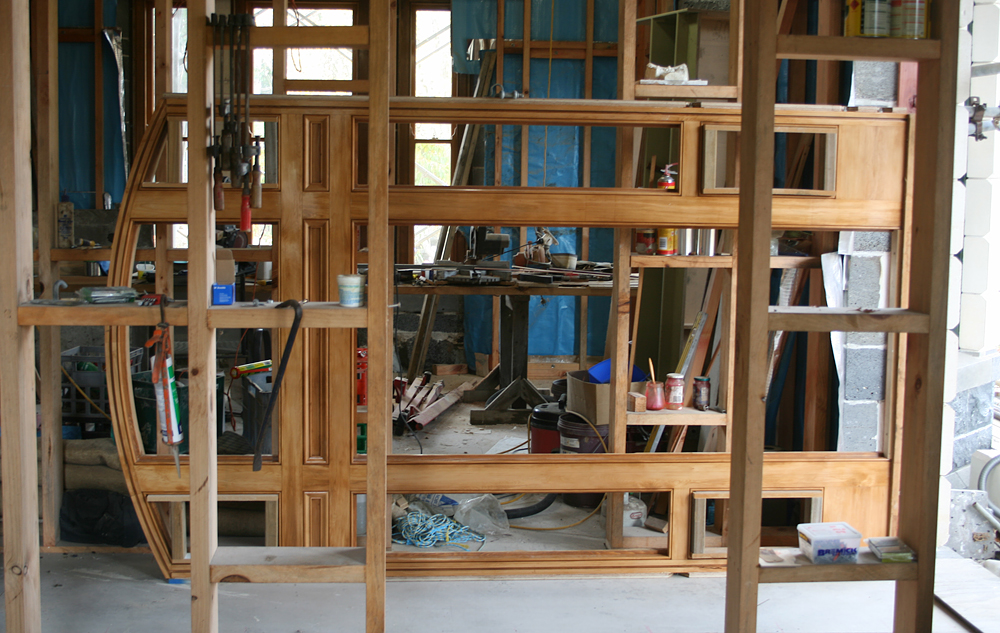
Having some time elapse since my attentions were drawn away from the door frame construction proved to be rather advantageous. The Celery top pine, on the dry fitted assembly, which I had assumed was very stable and had been sufficiently seasoned, shrunk somewhat in the dry summer heat.
The worst affected area was the joints on the large transom rail, where it crosses the mullions. The shrinkage caused the joints to open, creating an unsightly 2mm gap. This seemed quite excessive, but, given the width of this rail, the amount of movement was less than 1%.
Fortunately, with the inside face of the rail needing some form of embellishment, the fix was rather simple.
Firstly, I routed a 100mm wide rebate out along the centre line, 18mm deep, then sawed the piece in half.
When reassembling the frame, the two halves were wedged apart to tighten the joints. Then neatly cut infill blocks were inserted, to line up with the mullions.
Lebanese cedar veneer was then laminated to some 3mm ply, which I placed in the bottom of the rebate before the application of bolection mouldings. It did seem a pity to hack into such a nice section of timber, but as mentioned earlier, it needed some form of decoration.
With the main frame now permanently assembled and prior to inverting the whole unit, the inside face received a light staining and a couple of coats of clear lacquer. This would save any extra flipping of the heavy unit and protect the surface from any moisture damage. My main fear at this stage is from the risk of the resident "leaky" possums, who enjoy scurrying around on the exposed joists overhead. These, I am unable to exclude from the house, until the door and frame are completed and installed.
The joining of the lower rails to the mullions and jambs needed to be very solid. They would need to withstand any movement generated by the swinging and slamming of the door. To keep it all tight I drilled right through from the outer edges to within about 20mm of the door rebates on the mullions.
Pockets were drilled in from the outside face to intersect with the ends of the holes These allow for the fitting of washers and nuts to10mm threaded rod, which was pushed through the hole from the opposite end and they will later be covered with the frame pedestals.
The worst affected area was the joints on the large transom rail, where it crosses the mullions. The shrinkage caused the joints to open, creating an unsightly 2mm gap. This seemed quite excessive, but, given the width of this rail, the amount of movement was less than 1%.
Fortunately, with the inside face of the rail needing some form of embellishment, the fix was rather simple.
Firstly, I routed a 100mm wide rebate out along the centre line, 18mm deep, then sawed the piece in half.
When reassembling the frame, the two halves were wedged apart to tighten the joints. Then neatly cut infill blocks were inserted, to line up with the mullions.
Lebanese cedar veneer was then laminated to some 3mm ply, which I placed in the bottom of the rebate before the application of bolection mouldings. It did seem a pity to hack into such a nice section of timber, but as mentioned earlier, it needed some form of decoration.
With the main frame now permanently assembled and prior to inverting the whole unit, the inside face received a light staining and a couple of coats of clear lacquer. This would save any extra flipping of the heavy unit and protect the surface from any moisture damage. My main fear at this stage is from the risk of the resident "leaky" possums, who enjoy scurrying around on the exposed joists overhead. These, I am unable to exclude from the house, until the door and frame are completed and installed.
The joining of the lower rails to the mullions and jambs needed to be very solid. They would need to withstand any movement generated by the swinging and slamming of the door. To keep it all tight I drilled right through from the outer edges to within about 20mm of the door rebates on the mullions.
Pockets were drilled in from the outside face to intersect with the ends of the holes These allow for the fitting of washers and nuts to10mm threaded rod, which was pushed through the hole from the opposite end and they will later be covered with the frame pedestals.
Thursday, March 28, 2013
71, Flashing.
With the summer fire season setting in and after having completed much work in clearing hazards around the property, I could see that the biggest threat to our safety would be from ember attack. Most major bushfire's, in this part of the world, are fanned by strong, hot northerly winds. These normally change to blustery south westerlies when the cool changes arrive later on in the day. Fuelled by the oil rich eucalypt vegetation, the firestorms also create their own updrafts drawing all manner of burning material higher into the atmosphere and depositing it up to tens of kilometers in advance. I have vivid recollections of the Ash Wednesday fires, on the 16th of February, 1983. At that time, I was working on a car at my parents house in Torquay when, without warning, the sky suddenly turned black and burning embers began fluttering to the ground. This was one of the most terrifying moments of my life, I had no prior warning of the situation and it seemed like Armageddon had arrived!. That moment was when the wind changed direction, the fire had already been roaring in a southerly direction for a few hours and was still some 30kms distant, south west from us, near Lorne.
The temporary roofing, which I had installed over the ground floor, was originally only for the purpose of keeping the rain off the framing timber and to provide a dry work area. The gaps around the perimeter were sheltered by the higher roof sheeting on the scaffold. Now, with the ground floor near to being fully sealed following the installation of the windows, flashing's were moved to the top of the priority list. Wind blown embers, entering any internal cavities would spell disaster.
Being the bowerbird that I am, I had already accumulated a large assortment of odd flashings and sheeting. My supply, however, proved to be only barely adequate, I had seriously underestimated the amount required, not to mention the work involved in installation.
The job entailed the fitting of double folded flashings over the sheet ribs and up the inside of the stone walls, which were overlapped by apron flashings set into the horizontal mortar joints. The recessed door and widow openings, with their angled reveals, proved to be the most fiddly. The majority of these were formed to suit on my home made sheet folder, after being cut (and flattened) from the myriad of pieces I had collected.
More than a month was to pass before it was finally completed, but at least now I had some peace of mind. I can only hope that it ultimately proves to have been unnecessary!.
Stepped flashings were also fitted where the roofing on the original house abuts the "extension". Later, these will need to be replaced with permanent colorbond ones, once all the stonework is completed and the scaffold is removed.
The temporary roofing, which I had installed over the ground floor, was originally only for the purpose of keeping the rain off the framing timber and to provide a dry work area. The gaps around the perimeter were sheltered by the higher roof sheeting on the scaffold. Now, with the ground floor near to being fully sealed following the installation of the windows, flashing's were moved to the top of the priority list. Wind blown embers, entering any internal cavities would spell disaster.
Being the bowerbird that I am, I had already accumulated a large assortment of odd flashings and sheeting. My supply, however, proved to be only barely adequate, I had seriously underestimated the amount required, not to mention the work involved in installation.
The job entailed the fitting of double folded flashings over the sheet ribs and up the inside of the stone walls, which were overlapped by apron flashings set into the horizontal mortar joints. The recessed door and widow openings, with their angled reveals, proved to be the most fiddly. The majority of these were formed to suit on my home made sheet folder, after being cut (and flattened) from the myriad of pieces I had collected.
More than a month was to pass before it was finally completed, but at least now I had some peace of mind. I can only hope that it ultimately proves to have been unnecessary!.
Stepped flashings were also fitted where the roofing on the original house abuts the "extension". Later, these will need to be replaced with permanent colorbond ones, once all the stonework is completed and the scaffold is removed.
Saturday, January 12, 2013
70, Some flooring and Trimming.
During the past months, not all my time was wasted, tinkering with the Rotary convertor.
Two separate lots of decent secondhand chipboard flooring came up on eBay at reasonable "Buy it now" prices. It was just nicely enough to sheet the floor in the remaining ground floor rooms. It is only intended to be temporary and was lightly screwed to alternate joists. The permanent timber strip flooring, to avoid any possible damage, will not be fitted until all the major structural work is complete. There are thoughts, at the moment, going through my head of possibly laying some parquetry to the main areas, if this comes to fruition, the sheets will remain in those areas but will need to be further secured.
A couple of days was spent straightening the, now well seasoned, floor joists. The electric planer found it pretty tough going and blades were replaced a few times owing to the hardness of the "Box" timber and the amount of ingrained dirt it contained. This was despite using brushes and compressed air to clean them as much as possible.
The Lounge room,on the East side was the first to be done and, with a good platform to work on, I was able to "Stud" the external walls. This framing is non load bearing and creates a cavity for power and communication cables as well as the plumbing. It also provides some space for insulation to be inserted, to prevent the stone sucking out the heat during winter. The extra wall thickness created, also improves the aesthetics of the window recesses.
The west wall, laid before the "saw" days, was constructed using formwork on the inside. Laying the stone against it caused the excess mortar to squeeze out and spread across the face. At the time, I couldn't see an issue with this "unseen" side. Subsequently, however, I found that much of it can break loose fairly easily and can cause problems when trimming the wall. Pieces would drop down behind the insulating paper, jamming behind the framing making it difficult to straighten.
The first hot day of the Summer, the Sunday 2 days before Christmas, was spent chipping off the excess, in the relative coolness inside.
The wall, once cleaned, was much more pleasing to look at. In a way, it's a bit of a pity it will all be covered. The rows of bricks were placed to ensure a flat anchoring point for timber blocks, attached to the noggins for securing the framing. I wanted to get this done before the flooring was in place, cleaning up was easier, particularly along the edges around the bearers and the dust cleared better, falling to the ground.
Where it's at now. My current stocks of seasoned and dressed 70 x 45pine have been depleted, so the trimming of the Dining room, on the West side will have to wait for the time being.
With the fire season upon us, my attention has been diverted to the temporary roofing. I'm currently unable to fill the big hole in the front wall with the entrance door, but due to it facing south, it's not as concerning to me as all the gaps around the perimeter of the roof line. This may be the subject of my next post.
Two separate lots of decent secondhand chipboard flooring came up on eBay at reasonable "Buy it now" prices. It was just nicely enough to sheet the floor in the remaining ground floor rooms. It is only intended to be temporary and was lightly screwed to alternate joists. The permanent timber strip flooring, to avoid any possible damage, will not be fitted until all the major structural work is complete. There are thoughts, at the moment, going through my head of possibly laying some parquetry to the main areas, if this comes to fruition, the sheets will remain in those areas but will need to be further secured.
A couple of days was spent straightening the, now well seasoned, floor joists. The electric planer found it pretty tough going and blades were replaced a few times owing to the hardness of the "Box" timber and the amount of ingrained dirt it contained. This was despite using brushes and compressed air to clean them as much as possible.
The Lounge room,on the East side was the first to be done and, with a good platform to work on, I was able to "Stud" the external walls. This framing is non load bearing and creates a cavity for power and communication cables as well as the plumbing. It also provides some space for insulation to be inserted, to prevent the stone sucking out the heat during winter. The extra wall thickness created, also improves the aesthetics of the window recesses.
The west wall, laid before the "saw" days, was constructed using formwork on the inside. Laying the stone against it caused the excess mortar to squeeze out and spread across the face. At the time, I couldn't see an issue with this "unseen" side. Subsequently, however, I found that much of it can break loose fairly easily and can cause problems when trimming the wall. Pieces would drop down behind the insulating paper, jamming behind the framing making it difficult to straighten.
The first hot day of the Summer, the Sunday 2 days before Christmas, was spent chipping off the excess, in the relative coolness inside.
The wall, once cleaned, was much more pleasing to look at. In a way, it's a bit of a pity it will all be covered. The rows of bricks were placed to ensure a flat anchoring point for timber blocks, attached to the noggins for securing the framing. I wanted to get this done before the flooring was in place, cleaning up was easier, particularly along the edges around the bearers and the dust cleared better, falling to the ground.
Where it's at now. My current stocks of seasoned and dressed 70 x 45pine have been depleted, so the trimming of the Dining room, on the West side will have to wait for the time being.
With the fire season upon us, my attention has been diverted to the temporary roofing. I'm currently unable to fill the big hole in the front wall with the entrance door, but due to it facing south, it's not as concerning to me as all the gaps around the perimeter of the roof line. This may be the subject of my next post.
Labels:
arch,
basalt,
bluestone victorian basalt saw,
joists,
Sheet flooring,
stone,
victorian
Subscribe to:
Posts (Atom)