Before the windows could be installed, the vertical stone rebates needed to be trued and trimmed out with a jamb. The three earliest window openings, which I had constructed prior to the building of my stone saw, were made just wide enough to fit a window in snugly. Subsequently, I realised that a timber jamb would need to be fitted, in order to provide some method of securing the frame. In the photo above, the rebate on the right has now been shaved out to the required 100mm to accomodate a 21mm thick hardwood jamb, with the left hand side waiting to recieve the same treatment. The mortar joints needed to be chipped out before I could rough out the rebate using a chainsaw, with chisels and sanding blocks used for the final shaping. This wasn't one of the most fun, (or cleanest), jobs I have had to endure!
The 90 x 21mm hardwood jambs were glued and screwed to the limestone
using 100mm galvanised, countersunk "batten screws". These were driven
into pre positioned, Ultra Long RamPlug's, which were glued into cleaned, pre drilled holes using "liquid nails", before allowing a couple of days for it to set.
For subsequent windows I have found that a product called; KF2, a Polyester Injection System, (picked up from eBay, of course!), offers superior holding power for the screws and I now set the RamPlugs in with this. It is, although, more labour intensive, with a pilot hole needing to be bored, using a masonary drill, into the cured plug.
Working on my own, I was easily able to manouvre the windows around on their sides using pipe rollers, however, getting them up the steps and into the front of the house was going to be somewhat more difficult. To achieve this, I jury rigged an pole, with a swivel coupling, to the scaffold frame. This was supported, using a chain, from a higher level. I positioned it so that an attatched electric winch would pivot between a point above the landing, which was about the same height as my van floor, and the centre of the verandah. This system worked flawlessly and once at floor level, it was a simple matter to roll them where required.
With the bottom of the window frame shaped to fit into the rebate in the stone sill, the plan for the installation was to form a table at sill height, lift the unit on to it, apply the flashings and mounting brackets, locate the timber sill into the opening, then lift the window up into position. What I didn't allow for was the internal stone arch, which prevented the side/angled bay windows from being tilted up in this manner. To compound the problem, after wiggling the window almost into position, I was reminded of another issue.
Some years back, when laying the stone sills for this bay, a stuff up, on my part, had me place them about 10mm too high. This error wasn't picked up until setting out the limestone quoins, which were adjusted to suit, to ensure that the lintels were all level. I had completely forgotten about this by now and, of course, these were the only openings not checked when calculating the window dimensions. So then, of course, the odscenities started!.
Following my 5th attempt, after much planing, trimming, adjusting and swearing, the first window was finally in, but I am more than happy with the result.
To secure the windows to the jambs, I made a number of brackets from 3mm stainless steel angle. These measured about 30 x 22mm and were about 20mm wide. The long leg was screwed through the ply backing into the inner
lining and roofing screws, fitted through the other leg and drilled into the jambs, pull the frame
firmly into the rebate.
I didn't notice until uploading this image that
this particular mount was the one that needed to be rotated slightly, this was to
enable a new hole and screw to be drilled into the jamb. With all the refitting of this window, at least one screw had to snap!.
Showing posts with label sash. Show all posts
Sunday, July 8, 2012
Thursday, July 5, 2012
65, Windows, finally getting somewhere!
With a decision made on the glass, I could now make the glazing beads to suit. In the past, for this type of moulding I would make up a cradle to fit inside the thicknesser and run them through one at a time. There was usually a high mortality rate with this process, the rollers,when set firm enough to overcome the friction in the cradle, tended to crush the wood, causing it to curl. A lot of wastage was also normal, with about 200mm of the ends needing to be docked, this being due to excessive chatter occurring until the leading edge of the mould was steadied by the outfeed roller and after the trailing edge cleared the infeed roller.
My newest toy, the sander was pressed into action. I cut a tray, slightly longer than the longest bead, onto which I tacked and glued some sawn wood, of the same profile. The beads, sawn slightly oversize, were then placed in the corrugations and passed through the machine. I could sand six at a time and found the method worked perfectly, with no pieces being rejected or needing trimming as a result.
I produced enough beading's for all the windows, with about an extra 50 for spares, should any be needed down the track. With these ready, more monotonous labour then ensued, with the bulk of them being primed and receiving one top coat, all around.
Next on the agenda was the glazing. For the cutting of this, I stretched a blanket across my work table and clamped on a few wooden blocks, to cradle a large square.
The upper and lower sashes were made to have identically sized panes and I had taken great care to ensure that they were all true and of the correct dimensions. This enabled me to pre cut all the pieces of glass to set sizes.
From the same supplier as the double glazing materials; C.R.Laurence, I also purchased a number of silicon carbide sanding belts to suit my 4" sander. I was rather hesitant to go anywhere near the glass with this machine, as had been recommended to me, but it proved very successful in removing the sharp arris as well as sanding true any mis cut or oversized pieces.
I fitted the glass using a bead of "glazing sealant", a product by ROCOR. This stuff is water based and comes in cartridges, for use in standard caulking guns. It is designed for use with timber frames only. It forms a skin on it's surface but remains permanently soft and flexible. Any clean up of misplaced or squeezed out material is easily carried out by waiting for it to skin and simply rubbing it off. It is also just as easy to clean out, down the track, when replacing glass. It can be a bit hard to source but is available in Australia from Lincoln Sentry. I find it far superior to silicone, which can be a nightmare to clean off.
Once I had the sashes glazed, the outside faces were given another coating of gloss enamel before the final assembly. With that out of the way, the scales were then given a workout. The sashes were weighed and the cast iron weights were cut to suit. They were imbalanced by about 1/2 a pound, to give a slight bias to keeping the sashes closed.
More consideration was given to the provision of parting slips and I opted to fit them. If the idea of double glazing rears it's head again, sometime in the future, they would be necessary to prevent square cast lead weights from interfering with each other. Made from two laminated strips of 3mm ply, I screwed them to wooden blocks fixed at the top of the box's. They are normally poked through a slot in the head and secured by a dowel, but limited space over the windows precluded this method. If not fitted now and installation of them was required at a later date, it would necessitate the complete removal of the windows. After the weights were fitted, the box's were sealed with 10mm ply, screwed to the linings.
Finally, I could start to see some of fruits of my labour, the first completed window awaits loading into my van to be taken down the hill.
The brass latches were purchased via eBay from the UK. This was another typical example of how we are "ripped off" in this country. The total price, (buy it now), including the relatively expensive shipping cost of these items, manufactured by our Asian neighbours, was less than 50% of the cheapest Australian retail price I could source.
My newest toy, the sander was pressed into action. I cut a tray, slightly longer than the longest bead, onto which I tacked and glued some sawn wood, of the same profile. The beads, sawn slightly oversize, were then placed in the corrugations and passed through the machine. I could sand six at a time and found the method worked perfectly, with no pieces being rejected or needing trimming as a result.
I produced enough beading's for all the windows, with about an extra 50 for spares, should any be needed down the track. With these ready, more monotonous labour then ensued, with the bulk of them being primed and receiving one top coat, all around.
Next on the agenda was the glazing. For the cutting of this, I stretched a blanket across my work table and clamped on a few wooden blocks, to cradle a large square.
The upper and lower sashes were made to have identically sized panes and I had taken great care to ensure that they were all true and of the correct dimensions. This enabled me to pre cut all the pieces of glass to set sizes.
From the same supplier as the double glazing materials; C.R.Laurence, I also purchased a number of silicon carbide sanding belts to suit my 4" sander. I was rather hesitant to go anywhere near the glass with this machine, as had been recommended to me, but it proved very successful in removing the sharp arris as well as sanding true any mis cut or oversized pieces.
I fitted the glass using a bead of "glazing sealant", a product by ROCOR. This stuff is water based and comes in cartridges, for use in standard caulking guns. It is designed for use with timber frames only. It forms a skin on it's surface but remains permanently soft and flexible. Any clean up of misplaced or squeezed out material is easily carried out by waiting for it to skin and simply rubbing it off. It is also just as easy to clean out, down the track, when replacing glass. It can be a bit hard to source but is available in Australia from Lincoln Sentry. I find it far superior to silicone, which can be a nightmare to clean off.
Once I had the sashes glazed, the outside faces were given another coating of gloss enamel before the final assembly. With that out of the way, the scales were then given a workout. The sashes were weighed and the cast iron weights were cut to suit. They were imbalanced by about 1/2 a pound, to give a slight bias to keeping the sashes closed.
More consideration was given to the provision of parting slips and I opted to fit them. If the idea of double glazing rears it's head again, sometime in the future, they would be necessary to prevent square cast lead weights from interfering with each other. Made from two laminated strips of 3mm ply, I screwed them to wooden blocks fixed at the top of the box's. They are normally poked through a slot in the head and secured by a dowel, but limited space over the windows precluded this method. If not fitted now and installation of them was required at a later date, it would necessitate the complete removal of the windows. After the weights were fitted, the box's were sealed with 10mm ply, screwed to the linings.
Finally, I could start to see some of fruits of my labour, the first completed window awaits loading into my van to be taken down the hill.
The brass latches were purchased via eBay from the UK. This was another typical example of how we are "ripped off" in this country. The total price, (buy it now), including the relatively expensive shipping cost of these items, manufactured by our Asian neighbours, was less than 50% of the cheapest Australian retail price I could source.
Saturday, April 28, 2012
62, Sash assembly.
One detail, previously not mentioned, is the beading I had run on inside faces of the sash pieces. When I built my initial cottage, seen here in the beginning, It was designed and built around the 2 front windows. These I had rescued from one of the last remaining, original cottages in Torquay. Sited on the main Geelong road, it was being demolished to make way for the exploding surf industry. You can't stop progress, but it was all I could do at the time to preserve the past. The wood stove from the kitchen was claimed as well, but unfortunately, the chimney came down, rather quicker than was expected, and reduced it to scrap.
The beading's on these windows are the standard Victorian profile with the size matching the glazing rebate of 1/2" x 1/4", (12.7mm x 6.4mm). The curve segment is less than 1/4, giving it a flattened appearance. The balance of the windows in my cottage were a combination of some crappy recycled hardwood frames and 3 other sets I made myself, my first foray into this area. For these I purchased "off the shelf" moulded cedar, (western red), stiles and rails, although the beading moulding was different. I was happy with the results and the kitchen window is still working beautifully, the other two were removed to make way for the "extension". The construction of these gave me the confidence to completely make, from scratch, a new Bay window, shortly before I commenced the extension. This was to replace the large, rotting hardwood frame that I had installed in the west wall. This time I made some effort to replicate the original beading's using a small, 1/4 segment, concave router bit. I tweaked the stepped shoulders to get the nearest visual likeness that I could. This worked reasonably well, but, when it came to the windows for the main house, my standards were improving and near enough wouldn't be good enough!. For these I bit the bullet and ordered a new router bit, custom profiled. During my travels I had managed to procure an old wooden hand moulding plane with the correct blade for doing these, however, my enthusiasm for the construction did not quite stretch far enough to go down that path!.
Having all the main pieces machined, things became more hands on and fiddlier. The faces of all the stiles, at the base of the horns, adjacent to where the meeting rails join, had to made flush with the rebate and sanded smooth. The beading on the lower stiles was shaved back and scribed, however, on the upper stiles it was cut flush as, on these, there is no bead on the meeting rail.
The opposite ends of the stiles required rebates to be formed to accommodate the haunched tenons, this prevents the top and bottom rails from twisting. Then the beading's were also cut back and scribed.
A test fit of a meeting rail and a stile for a bottom sash. On the lower sashes, the glass fits up into a groove in the meeting rail .
No shed is ever big enough!. I could only scrounge enough room to set up two gluing tables and with the exception of the narrow sidelights, shown in the upper photo, I was only able to set up enough clamping for four sashes at a time. This worked out to be sufficient anyhow, as it was taking anything up to an hour to prepare each sash, this included the previously mentioned trimming and the fine tuning of the shoulders and scribes to true up the joints. I struggled to keep up, having enough sashes prepared for when the glue on the previous lot had set.
For 6 days straight, I had 2 clamping sessions per day, one about midday and the other about midnight. These sessions took about 2 hours each, by the time I coated the glued surfaces, assembled the sashes, lightly clamped and squared them, tapped the wedges firm, hammered in the joint wedges and then wiped all the excess glue from the faces.
I do possess an odd collection of sash clamps, but, when set up for this sort of work they tend to be unwieldy and hard to control. With their average lengths being about 1800mm, (6 ft), they would also require a lot more space. For this project I opted to assemble simple clamping jigs using wedges. The back blocks, being screwed down, could be easily relocated to suit the differing widths. I hadn't tried clamping this way before but was very happy with the method, it was very simple and effective.
By the last night, I was buggered, but was certainly glad to have had this bit over with.
At last, the sashes are together, all ready for trimming and sanding. They all look good, bar one. In my haste, (or stupor), to clamp up the final batch, I was careless with one joint, then over clamped it to close the gap, which led to it twisting. Fortunately though, it was for one of 2 sidelight windows which are fixed in place.
This simple jig, set up on my bandsaw, allowed me to quickly and neatly trim the waste from the wedges and tenons.
The joints are trimmed and the sashes are ready for sanding, before the trimming of the stiles, bevelling of the bottom of the lower sash's, grooving the sides for the ropes and fitting into the frames. There's still a long way to go....

The beading's on these windows are the standard Victorian profile with the size matching the glazing rebate of 1/2" x 1/4", (12.7mm x 6.4mm). The curve segment is less than 1/4, giving it a flattened appearance. The balance of the windows in my cottage were a combination of some crappy recycled hardwood frames and 3 other sets I made myself, my first foray into this area. For these I purchased "off the shelf" moulded cedar, (western red), stiles and rails, although the beading moulding was different. I was happy with the results and the kitchen window is still working beautifully, the other two were removed to make way for the "extension". The construction of these gave me the confidence to completely make, from scratch, a new Bay window, shortly before I commenced the extension. This was to replace the large, rotting hardwood frame that I had installed in the west wall. This time I made some effort to replicate the original beading's using a small, 1/4 segment, concave router bit. I tweaked the stepped shoulders to get the nearest visual likeness that I could. This worked reasonably well, but, when it came to the windows for the main house, my standards were improving and near enough wouldn't be good enough!. For these I bit the bullet and ordered a new router bit, custom profiled. During my travels I had managed to procure an old wooden hand moulding plane with the correct blade for doing these, however, my enthusiasm for the construction did not quite stretch far enough to go down that path!.
Having all the main pieces machined, things became more hands on and fiddlier. The faces of all the stiles, at the base of the horns, adjacent to where the meeting rails join, had to made flush with the rebate and sanded smooth. The beading on the lower stiles was shaved back and scribed, however, on the upper stiles it was cut flush as, on these, there is no bead on the meeting rail.
The opposite ends of the stiles required rebates to be formed to accommodate the haunched tenons, this prevents the top and bottom rails from twisting. Then the beading's were also cut back and scribed.
A test fit of a meeting rail and a stile for a bottom sash. On the lower sashes, the glass fits up into a groove in the meeting rail .
No shed is ever big enough!. I could only scrounge enough room to set up two gluing tables and with the exception of the narrow sidelights, shown in the upper photo, I was only able to set up enough clamping for four sashes at a time. This worked out to be sufficient anyhow, as it was taking anything up to an hour to prepare each sash, this included the previously mentioned trimming and the fine tuning of the shoulders and scribes to true up the joints. I struggled to keep up, having enough sashes prepared for when the glue on the previous lot had set.
For 6 days straight, I had 2 clamping sessions per day, one about midday and the other about midnight. These sessions took about 2 hours each, by the time I coated the glued surfaces, assembled the sashes, lightly clamped and squared them, tapped the wedges firm, hammered in the joint wedges and then wiped all the excess glue from the faces.
I do possess an odd collection of sash clamps, but, when set up for this sort of work they tend to be unwieldy and hard to control. With their average lengths being about 1800mm, (6 ft), they would also require a lot more space. For this project I opted to assemble simple clamping jigs using wedges. The back blocks, being screwed down, could be easily relocated to suit the differing widths. I hadn't tried clamping this way before but was very happy with the method, it was very simple and effective.
By the last night, I was buggered, but was certainly glad to have had this bit over with.
At last, the sashes are together, all ready for trimming and sanding. They all look good, bar one. In my haste, (or stupor), to clamp up the final batch, I was careless with one joint, then over clamped it to close the gap, which led to it twisting. Fortunately though, it was for one of 2 sidelight windows which are fixed in place.
This simple jig, set up on my bandsaw, allowed me to quickly and neatly trim the waste from the wedges and tenons.
The joints are trimmed and the sashes are ready for sanding, before the trimming of the stiles, bevelling of the bottom of the lower sash's, grooving the sides for the ropes and fitting into the frames. There's still a long way to go....
Thursday, April 19, 2012
61, Joinery, part four, Window sash preparation.
The tedium of assembly line work has reached new levels with the commencement of the sash construction. 23 window frames equals 46 sashes equals 92 stiles and 92 rails equals 184 wedged, mortise and tenon joints!
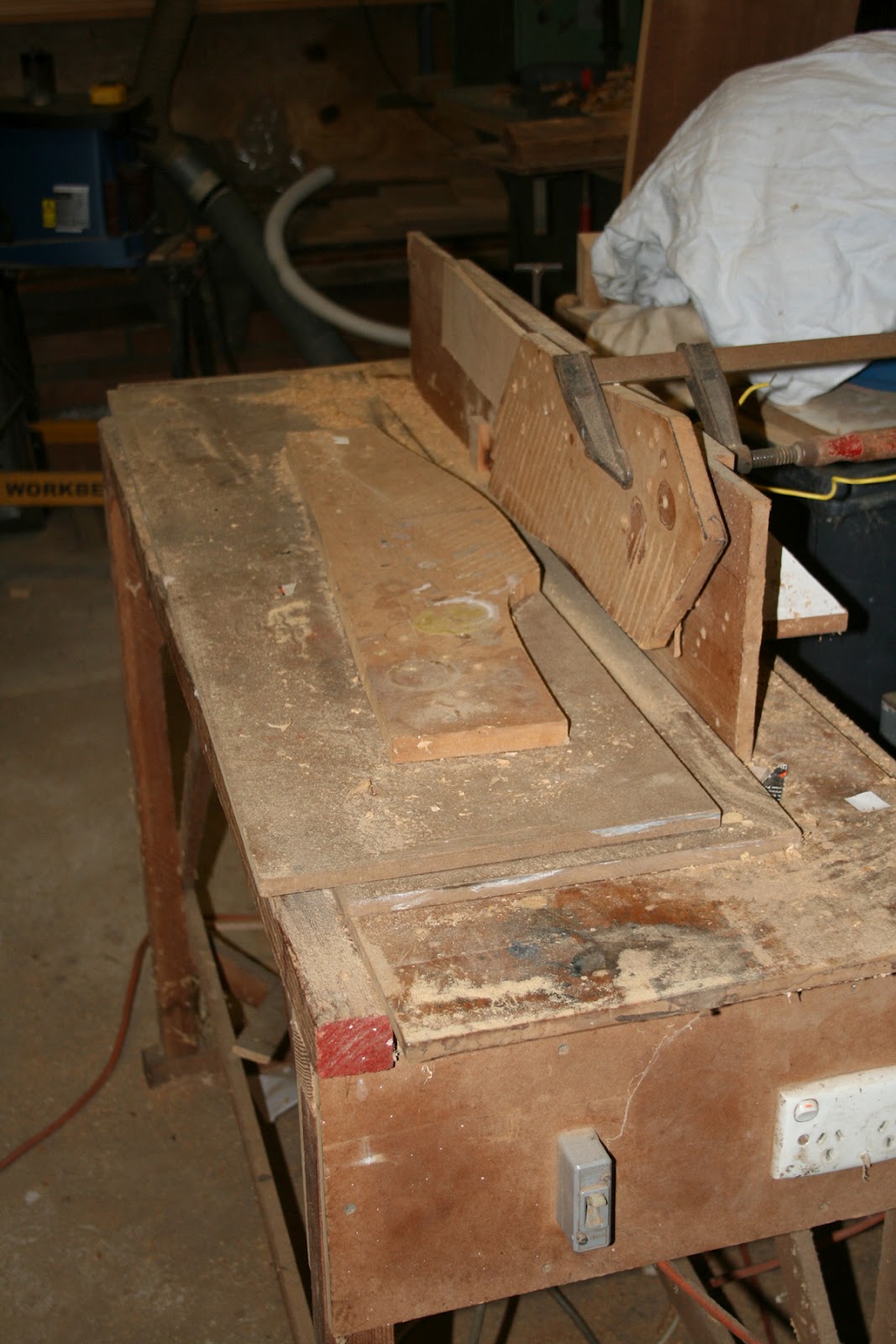
The mouldings and rebates I machined on my old home made router table. It has performed a massive amount of work over the years and the table top is almost past it's "use by" date, hence the extra sheets of Masonite to stiffen up and true the surface!
I had originally formed a 12mm deep, glazing rebate in the sticks before I stacked them away, this being more than sufficient for single glazing with plenty of room for beading's. The finished thickness of the sashes was 42mm and with a 12mm moulding on the inside, 16mm was left in the centre for the joints. In more recent times, however, I have been considering the inclusion of double glazing. Despite being over regulated in most aspects of building in this part of the world, we still have no requirements for this "luxury", it's just a "nice to have" item. Unfortunately, standard double hung windows don't readily lend themselves to being double glazed. Their future conversion, once assembled and balanced is also a job that I would not wish to tackle.
I carried out some homework and researched a variety of insulated glazing systems. One method I came across, that can be found here; superspacer, seems feasible. The product is distributed locally, (well, within 200km!) and is available down to 4mm in thickness. It doesn't require any special machinery or tooling to assemble the units and seems reasonably priced.
Some years back, shortly before my Father-in-law retired from his position at Pilkington glass in North Geelong, he was able to procure for us a large supply of 4mm thick glass for a fantastic price. I took delivery of of more than enough pieces for my needs and stored it all away in a sealed case, ready for this stage of the build. Using this glass and the 4mm superspacer, I could theoretically make 12mm thick, sealed units. This is not an ideal insulation solution, but it would certainly outperform any single glazing.
I toyed with the idea of increasing the rebate depth in the sashes to 16mm, they would then have enough room to fit these units. Very little space is left, however, for beading and I will need to rely on a bead of sealant to keep everything in place. I may need to do some more investigating on that.
I have opted to start heading down this path and ran all the pieces back over the router table to deepen the rebate. This then had the effect of reducing the joints to 12mm in thickness which, I figure, is still quite acceptable. The drawback of this action, however, meant that the joints would need be formed "off centre", creating more headaches with their construction.
My 'cheapie' chisel morticer, an invaluable tool for this sort of work. I have improved it considerably with the provision of a new base incorporating a two way, cross slide vice. To minimise "breakout" I cut the mortice's from both sides. The stiles did however, suffer a certain amount as, when drilling the first holes from the face, I set the depth stop a bit too deep, resulting in some splitting occurring on the outside. The mortice's were cut at 90deg. from the face, with the angled block being used when doing the back cuts to enable me to form the wedge shaped holes.
Stage 1 taken care of... 92 stiles with their mortice's complete.
Next on the agenda was the rails. I am currently the proud owner of three spindle moulders, the second two bought because each was better than what I already had and was offered for a "good price". At this stage, neither of the better two have been converted to single phase operation. The last bought machine, seen in the above photo, incorporated a slide groove in the table top and I opted to use this for the machining of the tenons.
The first thing to be done was the fitting of a router. The original spindle, which I had removed to lighten the load when bringing the machine home, was still separate. I turned up a new table insert to suit the router cutter, drilled and countersunk holes in it to align with tapped holes in the router base and then used this to clamp the router below the table.
That sorted, I knocked up a sliding table. This incorporated two separate right angle guides, each providing a different depth of cut, the price to pay for having offset joints. A fair bit of fiddling was required here, with various shimming sizes trialled until a balance was achieved for the two different shoulder depths.
To add to the headaches, a combination of 3 different window heights and 7 different cill lengths led to a total of 11 different window sizes.
Stage 2 over, the tenons complete. The meeting rails, in the foreground, were particularly fiddly to machine. The joints being partly cut on the bandsaw to allow the splayed edges to continue over the faces of the stiles.
Back to the stiles. The final thing to be completed, before assembly could be commenced, was to cut and sand the horns. There is a myriad of shapes and designs for these and indecision on my own choice was the reason for this being left until last.
I had scoured through all of my photo's and took a number of detours during my travels to identify as many different patterns as possible. I shortlisted my favourites and cut samples on some scraps. On presenting these to my wife, her choice actually matched mine when she selected the simple ogee, the same as on my original windows!. A couple of days of bandsawing and smoothing on my bobbin sander and the stiles were ready to go.
Monday, April 9, 2012
60, Joinery, part three, Window frames.
With the sander up and running I was able to finish preparing the timber for the window frames and assemble the units.
The machining of the pulley stiles proved to be a tedious chore, (most things I start seem to end up this way), each one needing to have a groove for the parting bead down the length of the face and cut outs, with rebates formed at the top ends to accommodate the brass pulleys. Many years back, when browsing through a restoration supplies store, I spotted a fantastic price labelled on these pulleys, I purchased about 100 of them, more than enough for my needs and stashed them away in the shed, below my workbench for "when I get a round 'tuit'"!.
By the time that I had finally commenced construction of the windows, I had forgotten about their existence and was investigating the purchase of more. I received a pleasant surprise when, as I was clearing the shed to create some more workspace for this part of my project, the dusty box was unearthed and it's contents revealed.
One slight issue that became apparent with these pulleys was that the solid axle was held captive by having its ends being beaten and flared outside the main casting. This necessitated the forming of a small notch at the centre of the rebate to allow the unit to be inserted. A trial fitting showed that the resulting gap was quite discrete so I proceeded down this path rather than risk damaging the pulleys with their modification. All going well, time will tell if this flaw in their design was the reason for the cheap price I had paid, not some other structural shortcoming. They seem to be quite solid solid units, being cast from solid brass.
Hidden pockets also had to be cut into the stiles, these being needed to access the counter balance weights, should any maintenance be required. I used a very finely kerfed, hobby saw blade, adapted to fit into a reciprocating saw to make the angled face cuts, this ensured a very neat, discrete joint. To minimise the width of the saw cut that runs along the parting bead groove, I fashioned a jigsaw blade from a section of fine hacksaw blade.
Normally, only the saw cuts were carried out on manufacture, with the pocket being split out when repairs are required. To avoid the risk of any unwanted damage occurring in the future, should this be necessary, when some form of mechanical leverage would need to be applied from the faces, I removed them now by tapping them from behind.
The pocket piece, when reinserted, is held in place by the stepped "V" joint on the top and 2 brass screws at the bottom.
After having the parting and staff beads fitted , the pockets are well hidden.
When designing the windows, I copied, in general, the construction methods used in the recycled windows that I had restored for my original house, however, a few minor alterations were made from information gleaned from various referencing material. I had considered rebating the stiles into the linings, as appears to have been a common practice, but as my originals, (which I had procured from different sources), were not made this way, I opted away from that. I had also seen old examples of windows constructed using this method, suffering from splitting issues due to the necessary removal and replacement of the staff beading's during maintenance. The benefit of an absence of nail holes was also considered, but this advantage would have been superfluous, as all the staff beads, reveals and architraves will be face nailed anyhow.
The assembled frames, almost ready for painting and the next stage of the fitting of the sashes. To summarise; The stiles, of celery top pine are rebated into and screwed to the heads. They are rebated, wedged and screwed into the Lebanese cedar cills. The external linings, also of celery top pine and the blackwood inside linings are glued and nailed on. The screws and external nails are galvanised and past experience had taught me not to put any fixings into any of the pulley rebates or weight pockets!. Once the cast weights are installed, plywood cover boards will be screwed on the outsides.
Whether or not to install a "parting slip" to keep the weights separated from each other, is one issue which the jury is still out on, I have personally found them to be unnecessary if the windows are plumb and they can be a hell of a nuisance when trying to access the front weight during repairs.
To facilitate the installation of the splayed reveals, when the windows are in situ, I am also considering running an angled groove down the inner linings, into which a tongue on the reveal will slot.
Another issue which has been haunting me is the method of how to actually fix the window into position in the stonework. My head has been tossing around all sorts of ideas for brackets etc., however, nothing real simple has, so far, come to mind.
The machining of the pulley stiles proved to be a tedious chore, (most things I start seem to end up this way), each one needing to have a groove for the parting bead down the length of the face and cut outs, with rebates formed at the top ends to accommodate the brass pulleys. Many years back, when browsing through a restoration supplies store, I spotted a fantastic price labelled on these pulleys, I purchased about 100 of them, more than enough for my needs and stashed them away in the shed, below my workbench for "when I get a round 'tuit'"!.
By the time that I had finally commenced construction of the windows, I had forgotten about their existence and was investigating the purchase of more. I received a pleasant surprise when, as I was clearing the shed to create some more workspace for this part of my project, the dusty box was unearthed and it's contents revealed.
One slight issue that became apparent with these pulleys was that the solid axle was held captive by having its ends being beaten and flared outside the main casting. This necessitated the forming of a small notch at the centre of the rebate to allow the unit to be inserted. A trial fitting showed that the resulting gap was quite discrete so I proceeded down this path rather than risk damaging the pulleys with their modification. All going well, time will tell if this flaw in their design was the reason for the cheap price I had paid, not some other structural shortcoming. They seem to be quite solid solid units, being cast from solid brass.
Hidden pockets also had to be cut into the stiles, these being needed to access the counter balance weights, should any maintenance be required. I used a very finely kerfed, hobby saw blade, adapted to fit into a reciprocating saw to make the angled face cuts, this ensured a very neat, discrete joint. To minimise the width of the saw cut that runs along the parting bead groove, I fashioned a jigsaw blade from a section of fine hacksaw blade.
Normally, only the saw cuts were carried out on manufacture, with the pocket being split out when repairs are required. To avoid the risk of any unwanted damage occurring in the future, should this be necessary, when some form of mechanical leverage would need to be applied from the faces, I removed them now by tapping them from behind.
The pocket piece, when reinserted, is held in place by the stepped "V" joint on the top and 2 brass screws at the bottom.
After having the parting and staff beads fitted , the pockets are well hidden.
When designing the windows, I copied, in general, the construction methods used in the recycled windows that I had restored for my original house, however, a few minor alterations were made from information gleaned from various referencing material. I had considered rebating the stiles into the linings, as appears to have been a common practice, but as my originals, (which I had procured from different sources), were not made this way, I opted away from that. I had also seen old examples of windows constructed using this method, suffering from splitting issues due to the necessary removal and replacement of the staff beading's during maintenance. The benefit of an absence of nail holes was also considered, but this advantage would have been superfluous, as all the staff beads, reveals and architraves will be face nailed anyhow.
The assembled frames, almost ready for painting and the next stage of the fitting of the sashes. To summarise; The stiles, of celery top pine are rebated into and screwed to the heads. They are rebated, wedged and screwed into the Lebanese cedar cills. The external linings, also of celery top pine and the blackwood inside linings are glued and nailed on. The screws and external nails are galvanised and past experience had taught me not to put any fixings into any of the pulley rebates or weight pockets!. Once the cast weights are installed, plywood cover boards will be screwed on the outsides.
Whether or not to install a "parting slip" to keep the weights separated from each other, is one issue which the jury is still out on, I have personally found them to be unnecessary if the windows are plumb and they can be a hell of a nuisance when trying to access the front weight during repairs.
To facilitate the installation of the splayed reveals, when the windows are in situ, I am also considering running an angled groove down the inner linings, into which a tongue on the reveal will slot.
Another issue which has been haunting me is the method of how to actually fix the window into position in the stonework. My head has been tossing around all sorts of ideas for brackets etc., however, nothing real simple has, so far, come to mind.
Labels:
blackwood,
celery top,
double hung,
sash,
weights and cords,
window
Subscribe to:
Posts (Atom)