
Monday, June 13, 2011

56, Front Steps, part one.

Most of my time from late October until March was spent doing internal work, altering the girls room to give them more space. With this taken care of, and with my holidays approaching in late March, I sat down and came up with a final design for the front stairs for the house. The access to this area has been a bit of a problem during the build, as the ground level at the front lies about 2.3 meters below the house floor level. The original plan was for a single flight but it became fairly apparent that this was not going to be practical or aesthetically pleasing.
My inspiration for the design was from a house that I had previously photographed in Hobart, Tasmania in 2005;


In 2008, when I headed over Bass Strait to purchase my little Kubota mower I relocated the house and gained permission from the more than helpful owner to take a closer look and get some better pictures.
The design, with the incorporation of three landings, resulted in a fairly large footprint and not wanting to risk any future movements to cause any breaking of the, yet to be sawn, stone treads, I over engineered the foundations and substructure.


When my holidays arrived, I got underway. The trenches, I dug by hand to more than a meter deep to ensure a solid foundation in the clay subsoil, the spoil being carted well out of the way to a low spot elsewhere in the yard. A lot of backfill will eventually be required when retaining walls have been constructed, but would be a nuisance and in the way at this stage.


With my intention to mix the concrete by hand, I poured the main footings in two stages. Firstly, I partially filled the trenches, to within about about 450mm of the ground surface, with blinding concrete. Next, I fabricated the reinforcing steel work, bending and welding the 16mm bar into sections ready to be tied together in situ.


As 3 to 4 cubic metres of concrete required for each of the 2 stages of the footings, (blinding and main), sufficient supplys of aggregate, sand and cement were required. I am fortunate, to have in the area, quarries that supply the local Gherang Gravel directly. The gravel, which normally contains a lot of clay is generally used for roads and driveways. However, when it is extracted from the pits, some pockets are found which are free of the clay. This is suitable to be used with only the addition of cement to form a good mix. Costing about 15 to 25 dollars for a loaded trailer, depending on the mood of the operator at the time, it is also very economical.


At the end of a long day, after mixing on my own, over 3 meters of Concrete, the foundations are done!.


Rising out of the ground, more concrete was mixed, this time in smaller doses. I formed a series of criss crossing beams, still being heavily reinforced to ensure the structures rigidity.
The Verandah, I had also redesigned to incorporate a central gable, stepped forward to enhance the whole shape of the structure. This necessitated the rebuilding of a portion of the base stonework to accomodate the offset. To support this work, I formed a heavily reinforced concrete beam, set into the existing wall and bearing on the original foundations.
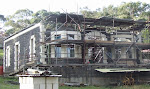
By now, my holidays were over and the above photo is what I had to show for them!


Stone quoins were required for the offset. This occupied a considerable amount of my time in their preparation, owing to their size and the dressing of the margins.


With the stone ready, I was then able to get on with the job of reconstructing the wall. I used concrete bricks below finished ground level and in the infill area, which will be covered by the steps. Although dismantling already completed work is very frustrating, the existing stonework on this wall was among the earliest that I had laid, therefore it was also among the roughest. So, replacing this with much neater work was certainly a consolation.

To be continued.....

Sunday, June 12, 2011

55, Where have I been?.

In the months since my previous post, most of my "computer" time has been spent working on the digitising of my slide collection. This was made possible following my acquisition of a good quality, dedicated slide/film scanner, purchased from the U.S.A. via EBay.
The subject matter of the vast majority of my accumulation of images is rail related, ie. trains!. From an early age I was captivated by the atmosphere of the Australian rail systems, with an ambiance of a working museum along with some fascinating architecture.
As I could see the decline in the network accelerating, it was obvious that the future was not going to be too kind with this part of our heritage. I photographed extensively from the mid '70,s to the mid '80,s, when corporatisation and rationalization took a firm hold and "sterilised" the whole scene. I was particularly interested in the vanishing branch lines, their very nature, through reasons of economy, prevented them from much modernization. My travels, with camera in hand, took me to all Australian mainland states, with the exception of Western Australia, but my heart remained in Victoria. Here, I gained employment with the "Victorian Railways" at the start of 1977 and, with the exception of a sojourn in the Building industry, I am still there, currently working for the current suburban franchise operator; "Metro trains" as a Train Driver.
I regularly upload some of my better pictures to; http://www.flickr.com/photos/24609616@N05/ pending a decision on a more permanent site. Other images, more related to the rail infrastructure, I have submitted to the "When there were stations" site, an ongoing work in progress.
An interest has also been shown to have some included in a couple of publications, the first, soon to be released by Nick Anchen, from Sierra publishing, is about Victorian Enginemen.

A more relevent posting, detailng my progress on the front steps for the house, will be up soon.

Saturday, October 16, 2010

55, Sill(Cill)(s) 2.

As fortunate as I was in the procurement of the window sills, (or cills if you prefer to spell them that way, I still can't make up my mind!), I was still left 1 short. This was needed for the side window in the main bedroom. The profile of my sills is a little different to the standard variety usually found in this part of the world. The shoulders on either side junction at a sharp 90 degrees with the upper sloping surface whereas on the common garden variety, of which I also have a small stockpile, they are concaved.
Not wanting to mix and match the sills on the house or cannibalise one of my other ones, I decided to make a new one from scratch.


The smallest stone in my collection with enough length to provide a sill of the required size, was, in a previous life, a capping stone. It came off the abutment of a small bridge located on the railway line near Little River, situated about mid way between Melbourne and Geelong. It was rendered obsolete many years ago when all the bridges and culverts along this line were strengthened, carried out by replacing the steel decks with new steel reinforced concrete ones. This necessitated the removal of the upper courses of stone and the installation of cast in situ concrete bearers.


Firstly I removed the rough back of the stone and then sawed off a slice about 5mm thick, (seen on the bench on the right). This was to ensure the soundness of the block, any unseen cracking would certainly become apparent on a piece this thin. Being happy with the result I then removed a suitable slab, cutting it about an inch thicker than needed to allow for final trimming.

I was a bit annoyed to find that a drill hole had been made into the base of the stone at some stage, for no apparent reason. The bulk of the original block, just shy of 600kg had made it a bit impractical to roll it over for a visual inspection. The hole ran about 3/4s of the way through and my saw cut had passed right across it. Fortunately though, with its angle and depth I was able to locate it within the waste area of the top bevel.


With the block positioned at the correct angle I then proceeded to make consecutive cuts about 1/2 an inch apart to remove the bulk of the waste.


The fingers were then broken and chiselled off.

The blade was then dropped slightly and the face tidied with the blade being moved sideways 1/16 of an inch after each pass.


With the bevel completed, the next step was to form the step to the front vertical face of the shoulders. I removed the bulk of the waste with a small angle grinder and then chiselled the surfaces true. Having completed these I then chiselled out the rebate to house the timber window sill at the top edge of the bevel.


Having all the upper profiles completed, the sill could then be trimmed to its correct dimensions. I started with the front face which received the same treatment as the bevel using consecutive saw cuts to emulate a tooled finish. This process testing out my sanity with a steady, continuous and monotonous 2 hours of back and forth for each face.

The Back, Head and Bed were next, with normal saw cuts sufficing.

The drip groove under the overhang could now be formed, taking care to stop short of the ends.

After some light chiselling to remove the radial saw marks on the seen areas of the trimmed ends it was ready to go!

3 days toil later and it's in its final resting place.

Thursday, September 23, 2010

54, Enough scaffold!


Following the purchase of the scaffold frames in February, I received the call I had hoped for in mid March. A scrap metal dealer in Laverton had for resale, a large number of steel planks. The asking price of $400 per 50 2.4meter planks had me making a couple of trips to transport about 110 of them home. These included a number of 1.8m planks, needed to make the correct run lengths. Many of them had seen better days and with a few nights spent in the shed with my welder, I was able to bring them back to a serviceable standard.

Now that I had enough gear I was able to completely encircle the whole house and have enough frames to take me up to final roof height. My tube and clip stuff mainly being used to support the temporary roofing over the work areas.

With the scaffolding taken care of I could get back to the stone laying. The aim at this stage is to raise the first floor walls to window cill height, about 600mm above floor level, around the entire perimeter. This is to allow the temporary roof, covering the ground floor timber framing, to be flashed sufficiently to prevent water entry. It will also, hopefully, enable me to seal the completed work sufficiently to prevent spark and ember entry in the event of a bushfire.


The East wall coming together. The limestone string course had to be stepped and broken, (just visible behind the inclined steel plank,) to allow for the stepped flashing over the existing roof.

For added strength I used a high proportion of full width tie stones for the first course above the limestone string course and reinforced concrete beam.

Wednesday, August 18, 2010

53, Helping out.

During July I was able to assist a friend, Steve, by cutting for him some 40mm thick slabs. These were to cap off some rubble stone retaining walls that he was in the process of constructing in the backyard of his and Maryanne's house in Footscray.
I had a large rock in my collection that was to be surplus to my requirements, as, externally it showed a texture that varied greatly from that which I was using. Steve was happy to use it, regardless of the texture, so I picked the 2 tonnes of it up with the loader and moved it next to the shed and power supply.


We first split the stone the easiest way across its width using the plugs and feathers. This proved to be a bad mistake for me, as the texture proved to be, for the most part, of very fine grain. Had we split it lengthways I would have been able to use it to provide me with 4 decent window sills or steps and I would have found another rock for Steve. Oh well, too late now!


The next step was to halve those pieces again to create more manageable blocks of about 250kg to load onto the saw.


These blocks I then sawed to the 300mm slab width that was required.


... and then laid these over to saw the 40mm slabs. I squared the ends of some pieces and left the rest at their full length for Steve to cut and mitre as required to fit.


The (almost) finished product! Job well done Steve!.

Tuesday, March 2, 2010

52, More scaffold!!!

My constant perusing of eBay, once again, paid off and I scored myself another deal. This time it came in the form of a quantity of scaffolding. A large number of steel "H" frames comprised the listing and were compatible with the frames that I already have. I negotiated a cash price per frame on the condition that I take the whole lot.
There was, however, one small drawback with the purchase. By road they were about 930km distant, in Liverpool, just out of Sydney.
I obtained a couple of quotes for transport to Melbourne of $600 and $650, which, to me sounded excessive, especially considering that I would still need to transport them the remaining 100km home. Having a third party pick up the frames would also have further drawbacks, as I needed to pay the seller in cash for all of the frames, the exact number not being determined until they were sorted and loaded.
Unable to procure a small truck for a reasonable price and all other options exhausted, I hitched up a trailer to my van and set off.


It was a pleasant drive and got me away from the place for a couple of days. The van, as in the above photo, paused for lunch on the return trip at Violet town was itself loaded inside with about a tonne. It handled it well, albeit a bit slow up some of the hills.


2 days, $305 of diesel fuel, 1 flat trailer tyre, a $68 overnight stay in a motel in and a couple of meals later I arrived at home. The final purchase totalling 72 frames .
I now have more than enough scaffold to completely encase the whole house, one more hurdle overcome. I am still on the lookout, however, for more steel planking.